
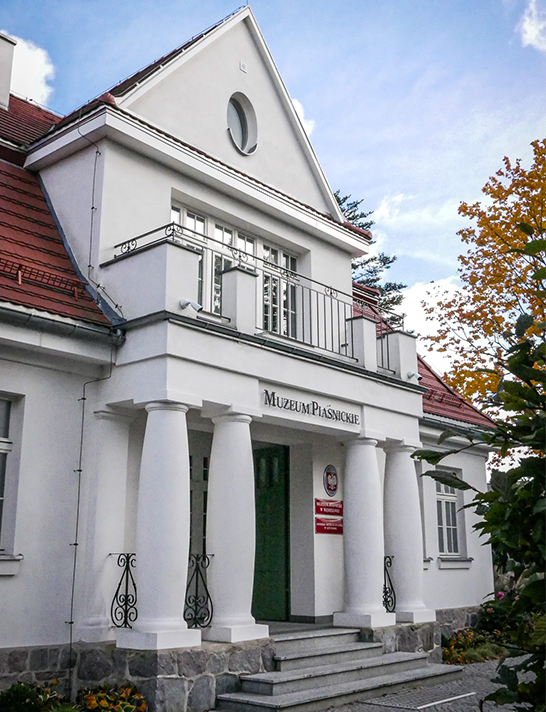
The permanent exhibition of the Piaśnica Museum consists of two parts.
The first part is located on the ground floor of the building. Its theme is the history of the interwar period, the construction of the Second Polish Republic after regaining independence, the history of the maritime district, the fate of the Pank family, and the people who created Polish statehood in Pomerania after 1920. This part of the exhibition is accessible to all age groups.
The second part of the exhibition is located in the basement of the building. Nine rooms present the history of the Piaśnica crime, its victims, and its perpetrators. This part of the exhibition can be visited by schoolchildren over the age of 13, i.e., seventh-grade students and older.
In addition, an outdoor exhibition on the wall surrounding the garden shows the events and people of the interwar period through articles and photos from the Pomeranian press.


Films
As a supplement to visiting the Museum and educational activities, we recommend viewing our selection of educational films. The Museum has a large educational and screening room and a second, smaller room. Films can also be screened in the café room.
Our selection includes the following films:

„Piaśnica”
It is possible to show the film divided into two parts. The first part can be shown without age restrictions. The film shows the development of Polish statehood in Pomerania and the problems associated with the integration of Pomerania with the rest of Poland. It presents the issue of Polish-German relations, taking into account the role of the German minority in Pomerania, the outbreak of war, and the situation in Pomerania after the outbreak of war. In the version divided into two parts, this is the first part of the film. The second part of the film shows the crime in Piaśnica, the post-war exhumations of the victims, and Forster's trial.

„Bednarz”
A film with no age restrictions. The film depicts the life and work of Józef Bednarz, a psychiatrist and director of the Psychiatric Hospital in Świecie, who was murdered by the Germans in the fall of 1939 in a mass execution in Mniszek, together with his patients. Dr. Bednarz is called the “Korczak of Pomerania” because he did not abandon his patients and died with them.
„Szpęgawsk”
Age restriction: 13+. The film depicts a German crime committed in the Szpęgawski Forest in the fall of 1939.
„Szpęgawsk. Część 2 Kocborowo”
Age restriction: 13+. The film depicts the extermination of patients at the National Psychiatric Hospital in Kocborów. They were murdered by the Germans in the Szpęgawski Forest as part of Operation T4 – the liquidation of terminally ill people.
„Pelplin”
Age restriction: 13+. The film depicts the German crime committed against the clergy of the Chełmno diocese in the fall of 1939.
„Pocztowcy”
Age restriction: 13+. The film presents the history of the Polish Post Office in Gdańsk in the interwar period and its heroic defense against the Germans on September 1, 1939.
„Antoni Abraham”
A film with no age restrictions. It depicts the life and work of Antoni Abraham.